An aging engine does not fail simply because its odometer crossed 75,000 miles. Wear changes clearances, seals harden, deposits accumulate, and oil-control rings can lose mobility. Choosing motor oil for high mileage engines is therefore a question of matching chemistry and viscosity to the actual failure mechanisms, not buying the most expensive bottle on the shelf. In the lab we call this boundary lubrication; on your shop floor, it means metal surfaces touch more often during startup, idling, and heavy load.
What changes inside a high-mileage engine
A new engine depends heavily on hydrodynamic lubrication. The crankshaft journal rides on a pressurized oil film, and the film keeps bearing metal separated from the journal. As bearings, journals, cam lobes, and piston rings wear, clearances can increase. Oil drains away more quickly after shutdown, and the engine may need more time to establish pressure during the first few revolutions.
Age also affects elastomeric seals. Valve-stem seals, front crankshaft seals, and oil-pan gaskets can become less flexible through heat and oxidation. High-mileage formulations commonly include seal-conditioning additives intended to improve elasticity and reduce seepage. That chemistry can help a damp gasket, but it will not repair a torn seal, damaged piston ring, or cracked oil pan.
Deposit control matters just as much. Oxidized oil can form varnish around hydraulic lash adjusters and sludge in narrow drain-back passages. A detergent keeps acidic and polar contaminants suspended, while a dispersant helps prevent soot and insoluble material from clumping into larger deposits. These are different jobs, even though both additives support cleanliness.
Application Note: If an older pickup has a dry dipstick after a long highway interval, first measure consumption and inspect for leaks. A thicker oil can reduce visible consumption, but it should not conceal a failing bearing or a blocked ventilation system.
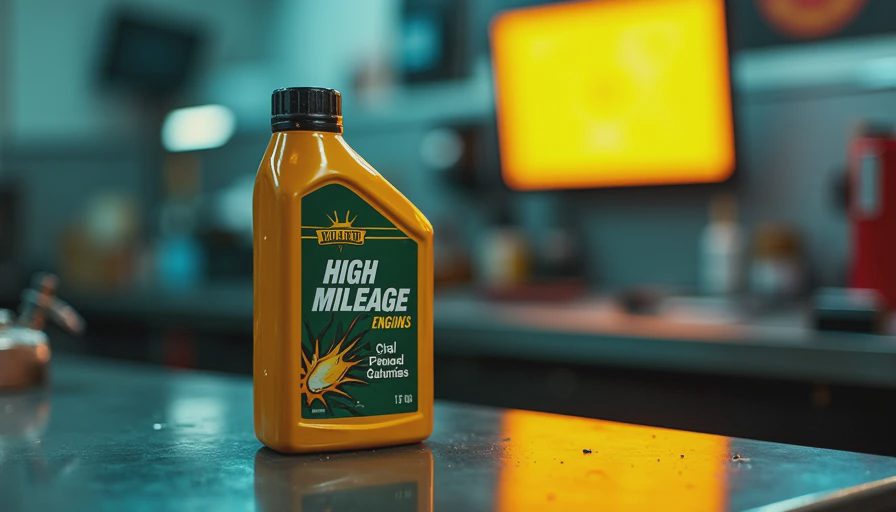
How to select viscosity without guessing
Viscosity is resistance to flow. The Society of Automotive Engineers defines engine-oil grades under SAE J300, using low-temperature cranking and pumping limits plus high-temperature viscosity requirements. The first number with a W describes cold behavior; the second describes viscosity at operating temperature. A 5W-30 and 10W-30 share the same hot grade, but the 5W-30 is designed to flow more readily during cold starts.
Start with the viscosity listed in the owner’s manual, then consider climate, oil consumption, and measured oil pressure. Moving from 5W-20 to 5W-30 can be reasonable for an engine that consumes oil in a warm climate, but it is not a universal cure. Modern variable-valve-timing systems and tight oil passages can depend on the specified viscosity. In cold northern states, an unnecessarily thick winter grade can slow cranking and delay lubrication.
For that reason, motor oil for high mileage engines should be selected by the complete grade, not by the words “high mileage” alone. A bottle labeled 5W-30 is still a 5W-30, regardless of whether it comes from Valvoline, Mobil 1, Castrol, Pennzoil, or a store brand. The additive package and licensing claims deserve equal attention.
Read the performance marks on the bottle
For gasoline vehicles, look for the current API performance category appropriate to the engine. API SP addresses modern concerns including low-speed pre-ignition protection in certain turbocharged gasoline engines, timing-chain wear, and deposit control. ILSAC GF-6A is another useful mark for many passenger cars using common grades such as 0W-20, 5W-20, and 5W-30. The exact requirement remains the vehicle manufacturer’s instruction.
Do not confuse viscosity with quality. Two oils can both be 10W-40 while carrying different API categories, OEM approvals, oxidation resistance, and volatility characteristics. A high-mileage label typically signals extra seal conditioners and a detergent-dispersant package, but it does not automatically mean the oil meets every manufacturer approval.
Diesel engines require separate attention. A light-duty diesel pickup may call for an API CK-4 oil, while a gasoline engine may specify API SP or ILSAC GF-6A. Diesel soot loading, turbocharger temperature, and emissions equipment place different demands on the lubricant. Never substitute a diesel formulation merely because it appears thicker.
Three failure modes, one root cause
The first failure mode is external leakage. Look around the valve cover, oil filter adapter, timing cover, and rear main seal area. A few drops after parking can become a serious loss during a 500-mile trip. Seal-conditioning chemistry may slow a minor seep, but cleaning the area and tracing the source is the sound diagnostic step.
The second is internal consumption. Blue exhaust under acceleration can indicate worn rings, while a puff after an overnight soak often points toward valve-stem seals. Before changing viscosity, verify the PCV system, compression, and leak-down condition. A stuck PCV valve can pull excess oil vapor into the intake and make a lubricant appear to be the problem.
The third is deposit-related restriction. Sludge around the oil-filler cap is not a complete diagnosis, but it is a warning. Inspect service history, cut open the used filter when practical, and avoid aggressive solvent flushes on an engine with unknown maintenance. Large loosened deposits can move into the pickup screen or small oil passages.
Application Note: When an engine uses one quart every 1,000 miles, an oil analysis cannot reverse wear, but it can reveal elevated iron, fuel dilution, coolant contamination, or abnormal silicon. ASTM D5185 is commonly used for wear-metal screening by inductively coupled plasma analysis.

Building a useful oil-change program
The best motor oil for high mileage engines is supported by disciplined service. Record the odometer, oil level, brand, viscosity, filter part number, and top-off volume. Check the level on the same flat surface, preferably after the engine has sat several minutes. A half-quart loss over 1,000 miles tells a different story from a half-quart loss over 5,000 miles.
Use a quality filter with an appropriate efficiency rating and a pressure-relief design suited to the application. Follow the owner’s interval unless severe service justifies shortening it. Frequent short trips, dusty roads, towing, extended idling, and repeated cold starts accelerate contamination and fuel dilution. In those conditions, a 3,000- to 5,000-mile interval can be more defensible than stretching every vehicle to 10,000 miles.
At each service, inspect the drain plug, filter gasket, belts, coolant level, and underbody. If the engine has suddenly developed low pressure, knocking, or a flashing oil warning lamp, shut it down rather than experimenting with a heavier oil. Mechanical diagnosis comes before lubricant optimization.
A practical buying checklist
When comparing motor oil for high mileage engines, use this sequence:
- Confirm the engine type, model year, and required viscosity in the manual.
- Match the API or ILSAC category, and verify any stated manufacturer approval.
- Choose a reputable full-synthetic, synthetic-blend, or conventional product based on service demands and budget.
- Check whether the formulation is intended for turbocharging, diesel service, or emissions-system compatibility.
- Pair the oil with a reliable filter and document the fill quantity.
- Monitor consumption for two service intervals before deciding whether a viscosity change helped.
A full-synthetic product such as Mobil 1 High Mileage, Valvoline Full Synthetic High Mileage, Castrol EDGE High Mileage, or Pennzoil Platinum High Mileage can offer strong oxidation and deposit control when its specifications match the vehicle. The brand is secondary to the correct grade, current performance category, filter, and service interval.
The central principle is straightforward: use motor oil for high mileage engines to manage wear, deposits, and minor seal seepage, not to disguise a mechanical fault. Read SAE J300 and API markings, measure what the engine is actually consuming, and let inspection and oil analysis guide the next decision. That is how laboratory lubrication theory becomes reliable maintenance in the real world.




No feedback yet — submit the first.