When someone searches for synthetic oil oil, they are usually trying to compare synthetic motor oil, confirm a product label, or understand whether two oil types can be mixed. The duplicated wording is not a separate lubricant category. It is a search phrase pointing toward an important practical question: which oil chemistry and viscosity will protect the engine under its actual operating conditions?
For a maintenance engineer or careful vehicle owner, the answer starts with the engine maker's specification rather than the word synthetic alone. A modern passenger-car engine may require SAE 0W-20 meeting API SP and ILSAC GF-6A. A turbocharged diesel pickup, motorcycle, generator, or marine engine can require an entirely different combination of viscosity, additive chemistry, and performance tests.
What synthetic oil oil usually refers to
Synthetic oil oil generally means synthetic motor oil, but “synthetic” describes the base-oil manufacturing route, not a universal performance grade. Base oils are commonly grouped under API 1509 categories. Group III oils are highly refined mineral-derived stocks, while Group IV refers to polyalphaolefin, or PAO, base oils. Group V includes other chemistries, such as esters, that are often blended for specific performance advantages.
The finished lubricant also contains detergents, dispersants, antiwear additives, antioxidants, friction modifiers, and viscosity-index improvers. These additives control deposits, oxidation, wear, and cold-flow behavior. A bottle labeled synthetic can therefore contain a carefully engineered blend rather than one chemically pure base stock.
In the lab we call this formulation design; on your shop floor, it means the oil must survive heat, fuel dilution, soot, moisture, and shear without losing its protective film. A premium base oil cannot compensate for using the wrong specification or an unsuitable viscosity.
Application Note: passenger vehicles
For a gasoline car, read the owner's manual and the container's approval language. API SP addresses modern gasoline-engine needs, including protection against certain forms of low-speed pre-ignition in turbocharged engines. ILSAC GF-6A is intended for many gasoline passenger vehicles using common low-viscosity grades. Do not treat a familiar brand name as proof of compatibility; the donut, starburst, or manufacturer approval is the useful evidence.

Viscosity is the first technical filter
Viscosity describes a fluid's resistance to flow. SAE J300 defines engine-oil viscosity classifications, such as 0W-20, 5W-30, and 15W-40. The number before the W concerns cold-temperature cranking and pumping behavior; the second number describes high-temperature viscosity limits. The W means winter, not weight.
A 0W-20 oil generally reaches bearings more readily during a cold start than a 10W-30, but that does not make it automatically better. Bearing clearances, oil-pump design, piston cooling, turbocharger requirements, ambient temperature, and fuel economy targets all matter. Using 20-grade oil in an engine designed for 40-grade oil can reduce the intended high-temperature film margin. Using an unnecessarily thick oil can increase pumping losses and delay circulation.
For industrial users, the same principle appears in hydraulic and gear systems. ISO VG 32, 46, and 68 are industrial viscosity grades, not interchangeable automotive engine grades. A lubricant marked SAE 5W-30 should not be poured into an ISO VG 46 hydraulic reservoir unless the equipment manufacturer explicitly permits it.
Why synthetic oil oil can help in severe service
Synthetic oil oil is often selected because the vehicle or machine experiences a demanding duty cycle. Frequent short trips leave condensation and fuel contamination in the crankcase. Towing raises oil temperature and load. Turbochargers expose lubricant to intense heat around the bearing housing. Cold climates increase starting resistance, while extended highway operation creates long periods of oxidation stress.
Synthetic formulations can offer strong low-temperature flow, oxidation resistance, and deposit control when properly formulated. Those advantages are especially valuable in engines with tight oil passages, variable valve timing, turbocharging, or start-stop operation. They do not make the lubricant immune to contamination. A severely fuel-diluted oil can lose viscosity, and a coolant leak can damage bearings regardless of base-oil quality.
ASTM D445 is used to measure kinematic viscosity, while ASTM D5800 addresses evaporative loss by the Noack method. These tests help describe behavior, but a single laboratory result does not replace the complete vehicle specification. Look for the required API category, ILSAC designation, ACEA requirement where applicable, or direct manufacturer approval.
Application Note: In a fleet of delivery vans, the maintenance program should track engine hours as well as miles. A van that travels three miles at a time can accumulate more cold starts and moisture exposure than a highway vehicle with the same odometer reading. Oil analysis, filter inspection, and a documented drain interval provide better evidence than a blanket claim that synthetic oil lasts forever.

Mixing, changing, and checking the lubricant
If the oil level is dangerously low, adding a compatible conventional or synthetic product is usually preferable to operating an engine without enough oil. Mixing does not instantly destroy the lubricant, but the resulting blend should meet the engine's required viscosity and performance category. Do not use mixing as a reason to extend the drain interval. Once different products are combined, the conservative maintenance choice is to follow the shorter established interval and return to one approved formulation at the next service.
A practical service procedure is straightforward. Confirm the exact viscosity and specification in the manual. Check that the oil filter has the correct bypass-valve and capacity requirements. Drain the warm oil safely, inspect it for fuel smell, coolant emulsion, metallic particles, or unusual sludge, and install the filter with the correct gasket treatment. Refill to the dipstick range, run the engine, wait for drain-back, and verify the level again.
Do not judge oil condition by color alone. Detergents can darken oil while keeping contaminants suspended, and a clean-looking sample can still contain fuel or wear metals. For critical equipment, laboratory oil analysis can measure viscosity, water, oxidation, nitration, and elemental wear metals. Trend data from the same machine is more useful than a single dramatic sample.
Choosing the right product without paying for marketing
Start with the specification, then compare price and service support. Major brands such as Mobil 1, Shell Helix, Valvoline, Pennzoil, Castrol, and Quaker State offer products across common passenger-car grades, but product lines differ by viscosity and certification. A lower-priced oil carrying the correct current specification can be a better choice than an expensive product that lacks the required approval.
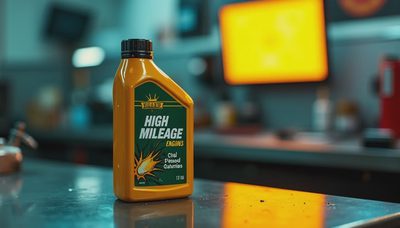
For an older engine with leaks, high mileage, or unusual consumption, a high-mileage formulation may include seal-conditioning additives and a different additive balance. It is not a mechanical repair. If consumption is one quart every 500 miles, identify the cause through compression testing, leak inspection, or crankcase-ventilation checks rather than simply moving to thicker oil.
For motorcycles, marine engines, and generators, avoid assuming passenger-car oil is suitable. Wet-clutch motorcycles may require JASO MA or MA2. Marine engines may specify a marine-duty oil and a particular API category. Generator engines often have explicit viscosity and service-hour requirements. The equipment manual outranks a generic internet recommendation.
The useful interpretation of synthetic oil oil is therefore simple: treat it as a request for a sound synthetic-lubricant decision, not as a special oil grade. Match SAE J300 viscosity, API or manufacturer performance requirements, equipment temperature, load, contamination risk, and drain practice. When those pieces align, synthetic oil oil becomes more than a search term; it becomes a disciplined maintenance choice that protects film strength, cleanliness, and reliability. Read the specification before the label, and contact a qualified lubricant specialist when the operating conditions fall outside the manual's examples.




No feedback yet — submit the first.