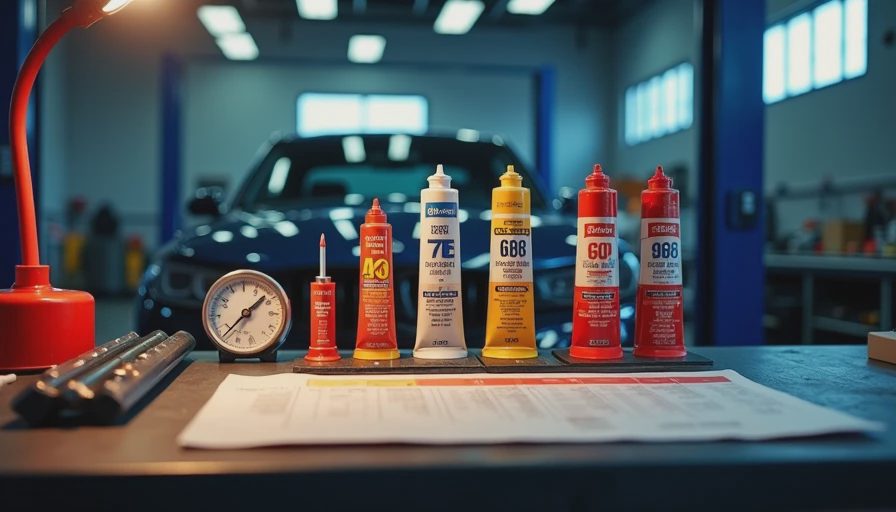
A **high temperature grease comparison chart** is only useful if it helps you prevent actual failure: coked bearings, softened grease, oil bleed, hard deposits, and accelerated wear. I see this problem constantly in electric motors, kiln auxiliaries, trailer hubs, disc brake hardware, and slow heavy bearings near furnaces. In the lab we call this thermo-oxidative degradation — on your shop floor, it means the grease that looked fine on the tube has turned into varnish, soap residue, or empty thickener with no lubricating oil left where the contact needs it.
The first point is simple: there is no single "best" high-temp grease. You need to compare base oil viscosity, thickener chemistry, oxidation resistance, load-carrying additives, water resistance, and speed factor. By the relevant standard, NLGI grade tells you consistency, ASTM D2265 gives dropping point, and ASTM D3336 or ASTM D3527 may be used to assess high-temperature bearing life depending on the product class. A chart should organize those variables, not hide them.
What a High Temperature Grease Comparison Chart Should Actually Compare
Most buyers start with dropping point, because it is easy to print and easy to market. That is a mistake. Dropping point is the temperature at which grease becomes fluid enough to drip under a test method, commonly ASTM D2265. It is not the same as continuous operating temperature. A lithium complex grease with a dropping point above 500°F can still oxidize quickly if the base oil and antioxidant package are weak for the application.
A useful chart should compare at least these columns: thickener type, base oil type, base oil viscosity at 40°C, NLGI grade, dropping point, recommended continuous temperature range, water washout behavior, EP performance, and typical use case. For example, polyurea greases often perform well in electric motor bearings because of oxidation stability and long life. Calcium sulfonate complex greases are often strong choices where water resistance and corrosion control matter. Bentonite or other clay-thickened greases can tolerate very high temperature exposure because they are non-melting, but they are not automatically the right answer for high-speed rolling bearings.

Application Note: If you are greasing a pillow block near an oven, include relube interval in the comparison. Heat alone does not kill grease; heat plus time does. A chart without relubrication guidance is incomplete.
Comparison Chart by Grease Family
Below is the practical version of a **high temperature grease comparison chart** I use when teaching reliability teams.
| Grease family | Typical strength | Typical caution | Common uses |
|---|---|---|---|
| Lithium complex | Versatile, widely available, good high-temp capability | Can struggle in severe water or extreme oxidation environments | Motors, general industrial bearings, automotive chassis |
| Polyurea | Strong oxidation life, good for sealed-for-life bearings | Mix compatibility must be checked carefully | Electric motor bearings, fan bearings |
| Calcium sulfonate complex | Excellent water resistance, corrosion protection, EP behavior | Can be more expensive, may not suit every speed range | Marine equipment, wet process bearings, heavy industry |
| Aluminum complex | Good water resistance and tackiness | Product performance varies widely by formulation | Food machinery in H1 versions, wet environments |
| Clay/non-soap | Non-melting behavior at high temperature | Poor pumpability in some systems, often weaker at high speed | Ovens, kilns, slow hot bearings |
| PFPE/PTFE specialty | Exceptional chemical and thermal resistance | Very expensive, not for casual substitution | Extreme heat, aggressive chemicals, specialty service |
That table is a starting point, not a final answer. In the lab we call this screening — on your shop floor, it means narrowing five bad candidates down to one likely success.
Matching Grease to Temperature, Speed, and Load
Heat never acts alone. The same grease that survives at 350°F in a slow conveyor roll may fail quickly in a small high-speed motor at half that temperature because shear, oxygen exposure, and relubrication limits are different. This is why a **high temperature grease comparison chart** must be read with DN value in mind. DN value is bearing bore in millimeters multiplied by speed in rpm; it is a practical shorthand for speed severity.
For high-speed bearings, lower base oil viscosity and strong oxidation stability usually matter more than extreme tackiness. For slow heavily loaded bearings, a heavier base oil and robust EP or antiwear package can be more valuable. For wet hot service, water resistance becomes central because water accelerates oxidation, washes out oil, and leaves surfaces exposed to corrosion.
Application Note: Disc brake slide pins and wheel bearings should not be treated as the same problem. Brake hardware greases often need compatibility with elastomers and resistance to road splash, while wheel bearings need rolling-contact lubrication under heat and load. Similar temperature exposure does not mean the same grease selection.
Compatibility, Relubrication, and Failure Modes
Three failure modes, one root cause — here they are: wrong chemistry, wrong interval, wrong amount. Grease compatibility is especially important when switching products. Some thickeners mix reasonably well; others can soften, harden, or bleed oil unpredictably. Always review supplier compatibility guidance and, in critical assets, purge or clean housings before converting. Polyurea in particular deserves caution when mixed with other systems.
Relubrication volume matters just as much. Overgreasing raises temperature, churns the grease, and can push oil away from where the rolling elements need it. Undergreasing leaves surfaces starved. By the relevant standard, consistency is expressed by NLGI grade, but the correct quantity is set by bearing geometry and operating condition, not by grade alone.
When you build your own comparison chart, add failure observations from used grease: color change, hardening, oil separation, contamination, and deposit formation. Those field clues often tell you more than a catalog ever will.
A Practical Buying Framework
If you need a working **high temperature grease comparison chart**, build it in this order. First, define the real continuous temperature, not the brief peak. Second, classify the bearing speed and load. Third, note water, steam, dust, or chemical exposure. Fourth, confirm whether centralized pumping, manual greasing, or sealed-for-life design affects consistency choice. Fifth, verify any compliance need, such as NSF H1 for incidental food contact.
My rule of thumb is straightforward. For general hot industrial service, start with lithium complex or polyurea and validate against speed and life. For hot wet service, look hard at calcium sulfonate complex. For very slow components exposed to extreme radiant heat, evaluate non-soap high-temp systems carefully. For truly severe chemical or thermal environments, specialty PFPE products can earn their cost.
The right chart does not just compare products; it compares failure risk. Build yours around ASTM and NLGI data, then temper it with field evidence. That is how a **high temperature grease comparison chart** becomes a maintenance tool instead of marketing wallpaper.




No feedback yet — submit the first.