The wrong oil can leave a loaded gear tooth without enough separation, upset a wet clutch, or shorten the life of a catalytic converter. Red Line is a lubricant brand with products for different applications, but the name on the bottle is not a substitute for matching the fluid to the machine. Start with the equipment maker’s required viscosity and performance specification, then check the exact product’s current technical data sheet. A racing oil, a street-engine oil, and a gear oil are not interchangeable simply because each carries the same logo.
Start with the application, not the base oil
Red Line offers automotive and powersports lubricants, including engine oils and gear oils. Before considering one for an industrial gearbox or marine engine, establish whether its documented performance and viscosity satisfy that equipment’s requirements. A product designed for a racing transmission may not be the right choice for a continuously operated plant gearbox with a different duty cycle, seal system, and oil-change interval.
The distinction begins with base oil and additives. Base oil provides much of the fluid’s viscosity and lubricating film; the additive package supplies functions such as oxidation control, corrosion protection, and wear protection. Some synthetic lubricant formulations use esters, but an ester component alone does not establish that a finished oil meets an equipment specification. The whole formulation matters.
In the lab we call this lubricant compatibility with the operating system — on your shop floor, it means the oil must work with the load, temperature, seals, filtration, and maintenance schedule as a package.
Application Note: For a circulating-oil gearbox, record the manufacturer’s specified oil grade, operating temperature range, and performance requirements before looking at alternatives. Include the gearbox model and service manual revision in the maintenance record. That gives a supplier enough information to assess suitability without guessing from the sump label.

Read viscosity grades without mixing up the systems
Viscosity is a fluid’s resistance to flow. Too little viscosity at the operating temperature can reduce the thickness of the separating oil film; too much can increase drag and make cold starts or circulation more difficult. When comparing Red Line products, use the grading system specified for the application rather than comparing numbers across systems.
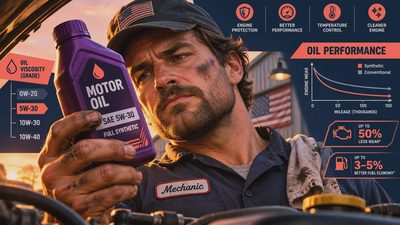
SAE J300 classifies engine-oil viscosity. A grade such as SAE 5W-30 describes low-temperature viscosity requirements associated with the 5W designation and viscosity limits at specified high temperatures for the 30 grade. It is not the same grading system used for industrial oils.
ISO 3448 defines ISO viscosity grades for industrial liquid lubricants using kinematic viscosity at 40 degrees Celsius. Kinematic viscosity describes a fluid’s resistance to flow under gravity. ISO VG 68, for example, has a midpoint of 68 square millimeters per second at that temperature and an allowable range around it. SAE J306 covers automotive gear-oil viscosity; a gear oil’s SAE number should not be read as though it were an engine-oil number.
The math is useful here: 40 degrees Celsius equals 104 degrees Fahrenheit. But a gearbox running at 80 degrees Celsius, or 176 degrees Fahrenheit, does not experience the oil’s 40-degree viscosity. Compare viscosity at operating temperature when data are available, and follow the manufacturer’s selection procedure. Viscosity index describes how much viscosity changes with temperature; it does not replace a grade or a performance specification.
Match the performance specification as well as the grade
An oil can have the right viscosity and still be wrong for the job. For a road vehicle, the owner’s manual may specify an API engine-oil service category or another manufacturer requirement. API categories address performance requirements; SAE J300 addresses viscosity. Check both on the exact Red Line product label or data sheet.
For a motorcycle with a shared engine and wet-clutch oil supply, look for the JASO T 903 classification required by the manufacturer. JASO MA and MA2 are classifications associated with clutch friction performance, among other requirements. Do not assume a car engine oil or a racing oil is appropriate for that clutch merely because its SAE grade matches.
Application Note: A mechanic servicing a shared-sump motorcycle should record the required SAE grade and JASO classification from the manual, then compare both with the product documentation. If the classification or manufacturer requirement is not documented, ask the supplier before filling. A friction-modified oil may behave differently in a wet clutch from a fluid selected for that system.
Gear oils demand the same care. API GL-4 and GL-5 describe different automotive gear-lubricant performance categories; GL-5 is not automatically a universal replacement for GL-4 in every manual transmission. Synchronizer behavior and material compatibility matter. For limited-slip differentials, also check the axle manufacturer’s friction-modifier requirements and the lubricant’s directions. Avoid adding a separate modifier until the fluid and axle documentation indicate it is needed.
What to check before changing fluids
First, verify the equipment maker’s requirements and the product data sheet for the exact Red Line fluid, not just a similar product name. Distinguish a formal approval or license from language saying a product is suitable for an application. If the documentation is ambiguous, obtain clarification in writing from the equipment maker or lubricant supplier.
Next, assess the changeover. Mixing different fluids can alter performance or create compatibility problems; the risk depends on their chemistry and the amount remaining in the system. Ask about seals, coatings, filters, and residual oil, particularly in an older machine or a large circulating system. A drain does not necessarily empty coolers, lines, or dead legs. Plan any flush around the equipment manufacturer’s instructions and a documented compatibility assessment, not an assumption that all synthetics mix safely.
Finally, establish a baseline. For equipment where oil analysis is warranted, take a representative sample from a consistent location while following the site’s safety procedure. ASTM D445 measures kinematic viscosity; ASTM D6304 measures water by Karl Fischer titration. Trending those results alongside wear metals and operating conditions can help identify changes, but neither a single water value nor a single metal reading diagnoses a failed component on its own.
Red Line can be a candidate when the exact fluid meets the documented requirements. The practical next step is to put the manual and product data sheet side by side, resolve any missing specification, and record the decision before the first gallon goes into the machine.



No feedback yet — submit the first.