A bearing can fail even when the grease gun is never far away: the lubricant may be too thin at operating temperature, contamination may have breached the seal, or the bearing may have been installed with the wrong adjustment. Timken is a bearing manufacturer, but its name also appears in a widely used lubricant test. Those are related topics, not interchangeable specifications. A high test result alone does not tell you whether a grease is right for a particular bearing.
For maintenance purposes, start with the equipment maker’s bearing and lubricant requirements. Then use test data to compare candidates that already meet those requirements. The distinction matters because a grease can resist severe sliding contact in a laboratory test and still perform poorly in a hot, fast, contaminated bearing.
What Timken makes and why the name appears on grease data sheets
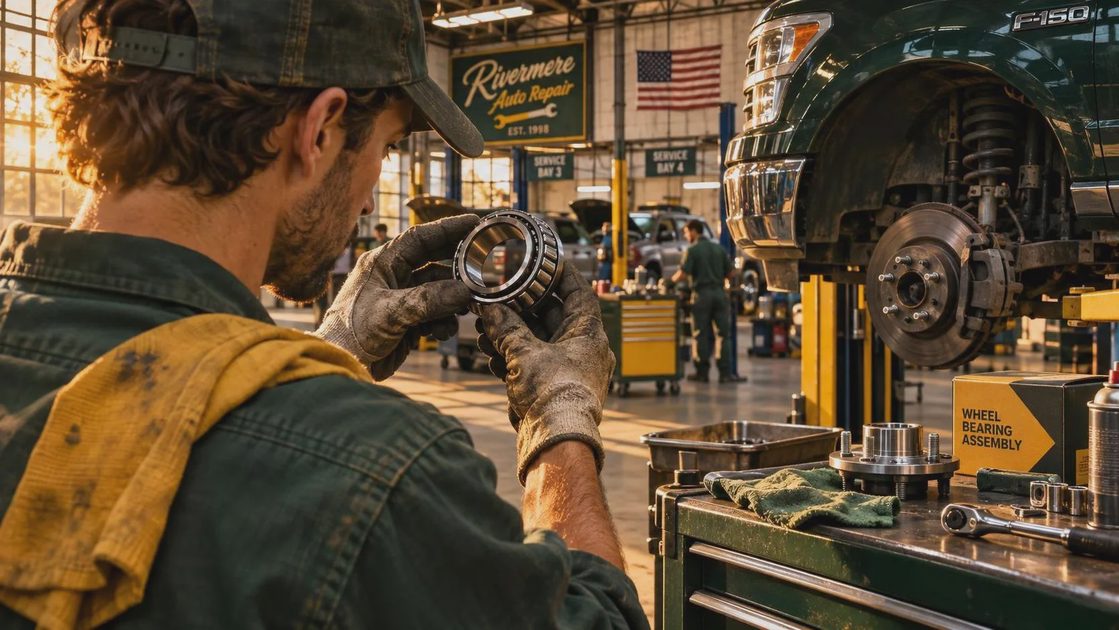
The Timken Company is known for bearings, including tapered roller bearings used in applications that must accommodate radial and axial loads. Radial load acts across the shaft; axial load acts along it. The company also offers other engineered motion products and industrial services. For a replacement, match the complete bearing designation and equipment requirements rather than relying on a similar-looking part.
On a lubricant data sheet, Timken may instead refer to an extreme-pressure test. Extreme-pressure, or EP, additives are chemicals designed to help protect contacting surfaces under severe conditions. They can form protective reaction films, but their effectiveness depends on the surfaces, temperature, contact conditions, and lubricant formulation.
In the lab we call this boundary lubrication: the surfaces are separated incompletely by fluid, so surface films and additives become especially important. On your shop floor, it means that starts, stops, shock loads, and inadequate oil supply can put bearing surfaces at greater risk of contact.
What the Timken OK load actually measures
ASTM D2509 describes a method for measuring the load-carrying capacity of lubricating grease with the Timken tester. ASTM D2782 covers a corresponding test for lubricating fluids. The tests use a rotating steel test cup against a stationary test block under specified conditions. The reported OK load is the highest load at which the test block does not show scoring under the method’s criteria.
Scoring is surface damage associated with severe sliding contact; it is not the same thing as rolling-contact fatigue, the progressive subsurface or surface damage that can eventually produce bearing spalls. The test is useful for comparing resistance to scoring under its particular conditions. It does not reproduce every contact, speed, temperature, or contaminant in an operating machine.
A Timken OK load reported in pounds is a test load, not the allowable load on a bearing. It is also not a direct prediction of bearing life. Compare values only when the products were tested using the same relevant method and reporting basis. A larger number may be useful evidence for a severe sliding application, but it is not a universal quality ranking.
Application Note: For a slow, heavily loaded conveyor bearing, an EP grease may be appropriate if the equipment maker calls for it. Check the specified base-oil viscosity, consistency, operating temperature, and relubrication practice first. Use ASTM D2509 results as supporting data, not as a substitute for those requirements.
Select grease for the bearing, not just the test
A grease consists of a base oil held in a thickener, usually with performance additives. Base-oil viscosity describes the oil’s resistance to flow; it influences the lubricating film that separates moving surfaces. ISO 3448 defines industrial liquid lubricant viscosity grades at 40 degrees Celsius. An ISO VG number describes the base-oil viscosity grade, not the stiffness of the finished grease.
NLGI consistency grades describe grease consistency, measured through worked penetration under ASTM D217. NLGI 2 and NLGI 1 are consistency designations, not direct measures of load capacity or base-oil viscosity. A softer grease may be needed for pumping in cold conditions, while a different consistency may be specified for a particular housing or sealing arrangement. Follow the machine maker’s recommendation rather than treating either grade as universally better.
Temperature changes the decision. Oil generally becomes less viscous as it warms, so a viscosity that looks adequate at room temperature may provide less separation at the bearing’s operating temperature. Conversely, an excessively viscous oil can create drag and heat in some high-speed applications. Ask the supplier for viscosity at operating temperature and verify the selection against the bearing manufacturer’s method.

Water resistance and corrosion protection also deserve separate checks. ASTM D1264 measures the resistance of grease to water washout under specified test conditions; ASTM D1743 evaluates corrosion-preventive properties of lubricating greases. Neither test guarantees performance against every washdown chemical, seal failure, or marine exposure. For a wet installation, inspect seals and water entry paths as carefully as the grease data sheet.
Diagnose a bearing before changing the lubricant
A failed Timken bearing is evidence to examine, not proof that the grease was defective. Preserve the bearing, housing seals, and a representative lubricant sample when practical. Record operating temperature, load, speed, relubrication quantity, and recent maintenance before cleaning away the evidence.
Contamination can leave dents and abrasive wear; inadequate lubrication can contribute to smearing, discoloration, or surface distress; incorrect mounting or adjustment can create damaging load distributions. These appearances can overlap, and heat discoloration alone does not establish a root cause. Compare the damage pattern with the manufacturer’s failure-analysis guidance and check shaft and housing fits against the applicable drawing.
Application Note: If a Timken tapered roller bearing runs hot after service, verify the specified setting and installation procedure before adding grease. The bearing arrangement may require a particular endplay or preload: endplay is controlled axial looseness, while preload is an intentional internal load. Too much grease can also generate heat through churning, so the corrective action depends on what the inspection shows.
Before mixing greases, consult the equipment maker and suppliers about thickener and additive compatibility. ASTM D6185 provides guidance for evaluating mixtures of lubricating greases; a compatibility chart alone cannot establish that a particular combination will remain suitable in service. When compatibility is uncertain, plan a controlled changeover and monitor the bearing afterward. That is a more defensible maintenance decision than choosing the product with the highest Timken number.



No feedback yet — submit the first.