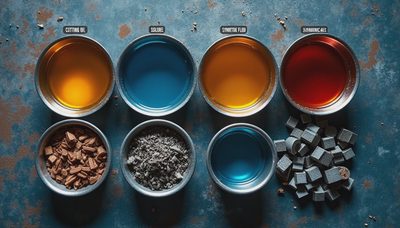
If you're managing a CNC shop or high-volume machining line, you've likely heard the buzz about **synthetic metalworking fluids**. In the lab we call this a water-miscible fluid engineered with no mineral oil — on your shop floor, it means exceptional cooling, cleaner sumps, and fewer disposal headaches. But is it right for every operation? Let’s break down the chemistry, the real-world trade-offs, and what the standards require.
What Are Synthetic Metalworking Fluids?
By the relevant ISO 6743 standard, **synthetic metalworking fluids** contain no mineral oil base. Instead, they use synthetic esters, polyalkylene glycols (PAGs), and organic corrosion inhibitors dissolved or dispersed in water. Unlike semisynthetic fluids (which blend small amounts of oil) or soluble oils (which are oil-in-water emulsions), synthetics form true solutions or very fine microemulsions. This gives them three defining traits: outstanding heat removal, excellent hard-water stability, and high resistance to bacterial growth.
Application Note: On a high-speed aluminum machining center running 18,000 RPM, a synthetic fluid at 5-7% concentration can reduce tool-tip temperature by 20°C compared to a conventional emulsion at the same dilution. That’s directly measurable in tool wear — expect 15-30% longer tool life under identical feeds and speeds.
Key Performance Advantages Over Conventional Fluids
**Cooling:** Water has a specific heat capacity roughly double that of oil. Because synthetic fluids carry more water to the cut zone (and less oil), they remove heat faster. For operations like deep-hole drilling or high-feed milling where thermal crack risk is high, this is a game-changer.
**Lubricity:** Don’t assume “no oil” means poor lubrication. Synthetic esters and PAGs provide boundary film strength that often equals or exceeds light-duty mineral oils. ASTM D3233 (Four-Ball Wear Test) Typically shows synthetics delivering wear scar diameters under 0.5 mm at moderate loads.
**Cleanliness:** Sump life is a major cost driver. Because synthetic metalworking fluids resist tramp oil emulsification and bacterial degradation, they can last 2-4 times longer than equivalent soluble oils when properly maintained. That means fewer dumps, less downtime, and lower disposal costs.
Selection Criteria for Your Machining Operation
Choosing a **synthetic metalworking fluid** isn’t one-size-fits-all. Consider these factors:
- **Material being machined:** Aluminum, copper alloys, and composites generally perform well with synthetics. For ferrous metals, ensure the formulation includes adequate rust protection — many synthetics use amine-based corrosion inhibitors that can stain yellow metals, so check compatibility.
- **Water quality:** Synthetic fluids are forgiving in hard water (up to 400 ppm CaCO3 typical), but extreme hardness can cause precipitate formation. Test your water and adjust concentration accordingly.
- **Operation type:** High-speed machining, grinding, and turning benefit most from synthetic cooling. For heavy broaching or thread forming that demands extreme pressure (EP) lubrication, a high-performance soluble oil may still be preferable — but some synthetic formulations now incorporate EP additives like sulfur or phosphorus.
Application Note: For a die-cast aluminum part with tight tolerances (±0.001 in), a 7% synthetic fluid with a pH of 8.5-9.0 is a typical starting point. Monitor pH weekly — if it drops below 8.0, add fresh concentrate or adjust with a pH buffer.
Fluid Management and Monitoring
Even the best **synthetic metalworking fluid** will fail if mismanaged. Follow these practices per ISO 12922 (Fire-Resistant Fluids) and general coolant maintenance guidelines:
- **Concentration control:** Use a refractometer or titration kit daily. Synthetic fluids often have a higher refractometer factor (1.2-1.8 for PAG-based products).
- **Biocide dosing:** While synthetics resist bacterial growth better, they are not immune. Include a biocide shock treatment if plating count exceeds 105 CFU/mL.
- **Filtration:** Use 10-20 µm filtration to remove swarf and fines. Synthetics can carry fines in suspension longer than emulsions, so bypass filtration is recommended.

Environmental and Health Considerations
One of the strongest arguments for **synthetic metalworking fluids** is reduced environmental impact. Because they contain no mineral oil, they are less toxic to aquatic life and easier to treat for disposal. Many formulations are now boron-free and use low-VOC corrosion inhibitors, aligning with EPA and OSHA best practices. However, they still require proper handling — wear gloves and goggles to avoid skin contact with concentrated amines. Recyclability is excellent: with proper filtration and concentration adjustment, synthetics can be reused almost indefinitely in closed-loop systems.
Conclusion: Is a Synthetic Fluid Right for Your Shop?
If your priorities are maximum cooling, extended sump life, and simplified waste treatment, **synthetic metalworking fluids** deserve serious evaluation. They aren't a universal replacement for all metalworking — heavy-duty forming and extreme-pressure applications may still call for oil-based products. But for the vast majority of machining, grinding, and light forming operations, a well-chosen synthetic will outperform conventional fluids on both performance and total cost of ownership. Consult your fluid supplier with specific material and operation data; run a four-week trial with proper monitoring. The lab says it should work — now prove it on your shop floor.