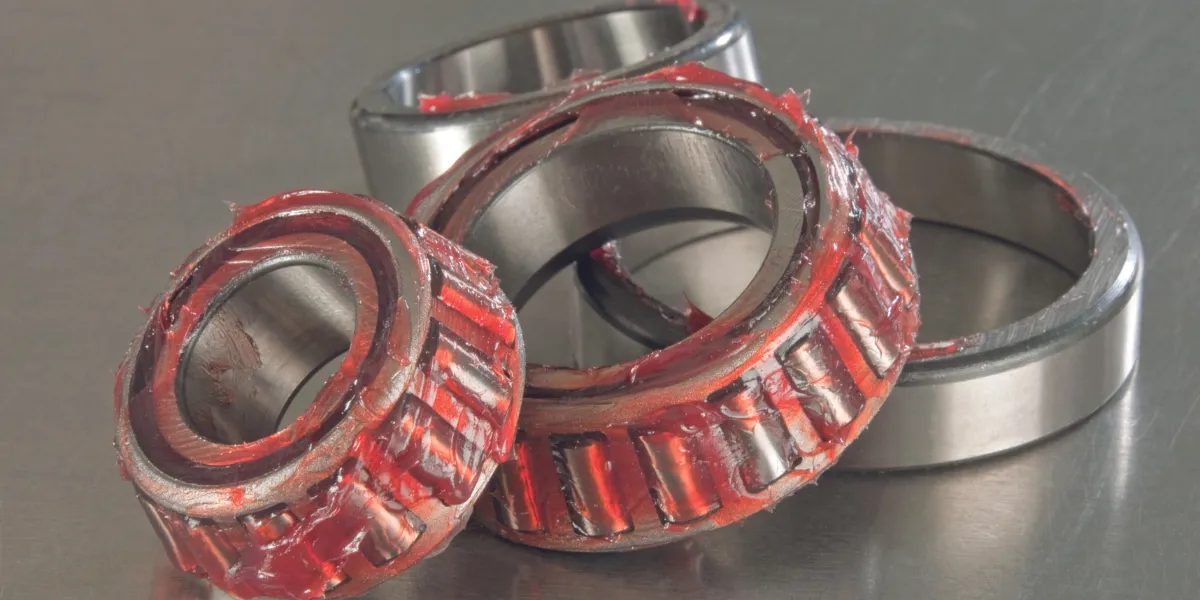
There are times when switching the type of lubricant used in your equipment becomes unavoidable. This decision grows considerably more complex when grease is involved rather than oil. Unlike oil, which can simply be drained before a new product is introduced, grease possesses inherent physical properties that make complete removal from a system extremely difficult prior to switching products.
This challenge complicates the decision to introduce a new grease into a machine — unless grease compatibility is factored into the equation. Today, various charts exist to illustrate which industrial grease will work alongside your current product. Most of these charts organize grease compatibility into three distinct categories: compatible, incompatible, and borderline compatible. To determine whether two greases are compatible, they must align in thickener type, base fluid, and additive composition. The resulting properties after mixing must also be evaluated.
If your plant or manufacturing facility is preparing for a heavy-duty grease change, the following covers everything you need to know about navigating that process:
The grease compatibility charts referenced above have been in circulation for over 50 years — and unfortunately, they haven't seen many updates along the way. Given how dramatically technology has advanced, we now have access to verified data that challenges the accuracy of certain charts and their underlying parameters. Modern innovations from Valvoline have produced updated formulations, best-in-class heavy-duty greases, and increasingly sophisticated grease application processes, all of which demand caution when relying solely on compatibility charts. That said, they remain a useful first-line reference for many applications, particularly when a grease change needs to happen quickly.
As noted, many organizations rely on compatibility charts to guide everyday maintenance decisions that carry real economic and operational consequences. These charts are widely accessible — appearing in scientific publications, trade periodicals, infographics, and across various websites. When selecting a chart, priority should be given to those that cite their data sources and are backed by substantive research. Despite their limitations, compatibility charts remain practical tools, applicable to everything from personal vehicles and small equipment to large-scale industrial grease replacements.
A number of grease compatibility charts consider only thickeners when addressing the question of mixing. Such charts deserve careful scrutiny, because grease actually contains three distinct components — thickener, base oil, and additives — and all three warrant consideration. When blending oils, it is standard practice to account for viscosity, base oil type, and thickener. Why these same parameters are frequently overlooked in grease compatibility assessments is not entirely clear. One plausible explanation is that most grease mixing problems originate from differences in thickener type. Regardless, all three parameters are worth examining in detail to understand how each influences industrial grease mixing:
Greases fall into two broad categories: those formulated with mineral oils and those built on a synthetic oil base. In certain cases, synthetic-base greases are incompatible not only with mineral oils but also with other synthetic base products. Consequently, base oil type must be a central consideration when evaluating compatibility. Even when thickeners are compatible, incompatible base oils will still produce a problematic mixture that degrades performance. Viscosity is also a factor that must be evaluated in any lubricant selection scenario. When greases of differing viscosities are blended, the resulting mixture will fall short of optimal performance.
It is now clear that, in the context of mixing oils, any incompatibility can erode performance and encourage the formation of deposits. The same principle holds true for additive incompatibility. Whereas incompatible additives in oils may simply settle out at the bottom, in grease they compromise the lubricant's effectiveness and can, in certain situations, create conditions that promote corrosion. For this reason, verifying additive compatibility across all lubricated components is essential.
Perhaps the most visible and immediate consequences of grease compatibility issues arise when greases with incompatible thickeners are combined. Some blends soften so drastically that they migrate past seals and are lost from lubricated surfaces entirely. Others cause the thickener to release base oil, which then flows freely. In other instances, the mixture hardens, placing excess load on components and severely restricting grease mobility.
The difficulty is that most of these effects are not readily apparent through casual observation. Simply combining two greases and watching for obvious changes will rarely reveal meaningful results. However, when grease mixing, working, and heating are conducted in controlled environments using varying ratios, measurable changes can be detected. This controlled approach remains the most reliable method for predicting how a grease blend will actually perform inside a machine.
Because most plant environments are not closed systems, some degree of grease mixing is nearly impossible to eliminate entirely. However, specific steps can be taken to reduce mixing to a minimum — particularly when incompatible greases are involved:
All personnel who handle and apply heavy-duty grease must receive thorough training and clear, accurate information about the products they are working with. The correct product must be used on each piece of equipment based on its material composition, intended use, and operating environment. Any employees or contractors who come into contact with lubricants should also be trained in proper labeling and color-coding practices — where applicable — to minimize the risk of product confusion.
Grease mixing frequently occurs with new or recently repaired equipment arriving at a facility. Even well-trained workers and managers may encounter situations where incoming equipment — motors, gears, bearings, and similar components — arrives pre-lubricated with a grease that differs from the one designated for ongoing service. This factory-applied grease may be entirely incompatible with the facility's standard product.
Determine the minimum range of products necessary to meet the design specifications of the facility's equipment, then adhere strictly to that selection. Maintaining excess inventory for the sake of convenience or brand preference often increases the likelihood of accidental mixing.
In situations where an incorrect grease has been applied to a machine or a transition between grease types is required, testing of the potential mixture should be carried out first. This process reveals how the two greases interact and gives technicians insight into the dynamic properties of the blend. If the mixture proves incompatible, prompt action to flush the machine and remove all traces of grease from affected components becomes far more manageable. Acting quickly limits exposure, preserves equipment life, and supports reliable long-term operation.
Grease blends can be organized into three compatibility categories:
While this framework seems straightforward, some heavy-duty grease specifications focus exclusively on performance and pay no attention to composition. This creates risk: if greases containing different thickener types are combined — even when both meet the required performance specifications — the outcome can be catastrophic.
In real-world applications, compatibility testing on various grease combinations is essential before those combinations are used in service. Although compatibility tables provide a starting framework, users can and should verify compatibility themselves when transitioning between products. In most cases, reputable heavy-duty grease suppliers maintain data on specific grease combinations and are able to provide guidance, consultation, and technical recommendations regarding their products.
Because the consequences of mixing incompatible greases are not always intuitive, ASTM International (American Society for Testing and Materials) developed a Standard Practice for Evaluating Compatibility of Binary Mixtures of Lubricating Greases. Originally published in 1997, this document remains a valuable starting point for those seeking to evaluate fundamental grease compatibility. It outlines the dropping point, mechanical stability, and consistency changes that occur in a mixture following the heating process.
According to this standard, greases are considered compatible when they satisfy the following conditions:
Once compatibility is confirmed across all three of those criteria, further testing is recommended to assess the full impact on additional performance parameters. Any of the established test methods designed for measuring grease performance can be applied to the mixture evaluation. When establishing absolute compatibility is critical, the appropriate course of action is to contact the grease manufacturer directly and request testing support. Consultation with experienced lubrication technicians can also prove invaluable in reducing the potential for costly errors.
Even seasoned lubrication technicians can encounter difficulties when working through grease compatibility, so it is entirely understandable that mistakes occur. The most frequent error arises when grease specifications focus solely on performance while ignoring composition. In such cases, combining two greases that share the same performance profile — for example, industrial greases rated for high-temperature operation — but have incompatible compositions can lead to serious mechanical consequences.
Another frequently observed error involves the compatibility assessment of polyurea and complex lithium greases. In some formulations, polyurea greases contain thickeners that are entirely compatible with lithium soaps, while in others they are fundamentally incompatible.
To prevent these kinds of grease compatibility problems, mixture testing should be conducted any time a grease type change takes place. Using established standards, grease binary mixtures can be evaluated against the three performance measures identified above: dropping point, mechanical stability, and consistency.
Because grease has such a significant influence on machine performance, reliability, and service life, selecting and managing it carefully is not optional — it is a strategic necessity. Grease compatibility charts are a helpful tool for making informed decisions when blending greases in machinery and vehicles. However, as this guide has made clear, these charts are not infallible. In most situations, the complexity of interactions among base oils, additives, and thickeners calls for a more rigorous approach to compatibility evaluation. Investing in mixture compatibility testing, taking proactive steps to prevent unintended grease mixing, and avoiding intentional blending wherever possible will yield meaningful long-term returns.
Our dedicated Valvoline team is ready to address any questions you may have about lubricant mixing and product selection. Drawing on more than 150 years of expertise, we are equipped to meet every consumer need in the lubrication field. Valvoline industrial grease products are engineered to keep vehicles, machinery, and all other equipment running at peak condition for as long as possible, enabling businesses to operate without interruption and with maximum efficiency and profitability.
For additional information, reach out to your Valvoline distributor or explore the wide range of helpful grease resources available on our website.





No feedback yet — submit the first.